Why Group Experiences Outperform Solo Attractions in Family Entertainment Centers
There is a moment that happens in almost every family entertainment center, every weekend, across thousands of venues around the world.
A family walks in. Mom is holding her phone, dad is scanning the floor, and the kids are already running.
Within 90 seconds, the group splits.
One kid heads to the arcade, the other finds a VR attraction. Then, them om sits down because there is nothing for her to do yet. They spend the next 45 minutes doing different things in the same building, occasionally checking in with each other, until someone gets hungry or tired and they leave.
Nobody had a bad time., but have they shared a moment?
That is the performance gap the Experience Economy has been pointing at for years, and that most FEC operators are still not measuring.
In 2026, it is getting more expensive to ignore.
Solo Attractions Were Built for Throughput. Not for Making Amazing Memories
Most FEC attractions are designed around the individual play unit. A single rider, a solo headset, a two-player lane that turns one person into a spectator while the other takes their turn.
These formats solve for throughput. They were not built for the thing that actually drives return visits in the Experience Economy: a memory the whole group shares.
The Difference
The difference between a solo experience and a group play experience is not just how many people are involved. It is whether the peak moment happens to one person or to everyone at the same time.
When a group plays simultaneously, they produce one shared experience. The reaction, the laugh, the near-miss, the “did you see that?” all land at once. That shared reaction is the memory: and memory is what brings guests back to your FEC.
Tip:
Research shows that experiences designed for simultaneous group participation have a higher replay rate than experiences where guests take turns or play individually. The reason is not the game, but rather the group’s reaction to the game.
What the Data Says About Group Play in FECs
The case for group play in family entertainment centers is not just about guest satisfaction, it shows up directly in the numbers operators care about most.
Research from the Sports & Leisure Research Group shows that 53% of guests now prioritize unique, memorable experiences over traditional value-based decisions. That number was 39% just a year ago. Guests are no longer asking only “How much does it cost?” They are asking, “Will this be worth my time?” and “Can I do this with the people I came with?”
Why Traditional FEC Attractions Fall Short for Group Play
The most popular attraction formats in FECs were not designed with the full group in mind. Each has a structural limitation that works against shared group play.
Escape rooms work well for adults but frequently exclude younger children who get bored or anxious. Capacity is limited and reservations create friction, while VR is technically accessible to all ages but socially isolating by design.
Guests in headsets cannot see or react to each other, which is the opposite of what the Experience Economy rewards.
None of these formats are broken, but none of them solve for the spectator problem: the family member who is not playing yet, watching, waiting, checking their phone.
The FECs outperforming their markets right now are the ones that have stopped tolerating the spectator problem and started engineering against it.
Attractions where the 7-year-old, the teenager, and the parent are all physically inside the experience together, where the group does not have to coordinate turns because everyone is already in.
Tip:
And most importantly, everyone enjoys the experience: it’s neither too childish or too complex for the younger audience.
Shoulder-to-Shoulder: The Group Play Format That Changes the Outcome
The term gaining traction among FEC operators is shoulder-to-shoulder gameplay. Not turn-based. Fully simultaneous, shared, reacting-together group play where everyone is in the same space, seeing the same thing, at the same time.
It is a design principle, not necessarily a product category. And it is the clearest predictor of whether a group experience produces a memory worth talking about or just an activity that filled an hour.
Attractions built around shoulder-to-shoulder group play share a few characteristics.
Everyone plays at the same time with no waiting, no watching, and no turns. Everyone sees and reacts to each other during play. And everyone shares the same peak moment at the end, the moment that becomes the story on the drive home.
That last part is the one that matters most for FEC operators. The story guests tell after they leave is the most efficient marketing spend available. It cannot be manufactured with signage or a loyalty program. It either gets produced by what happens inside the attraction, or it does not.

How QBIX Delivers Group Play in Family Entertainment Centers
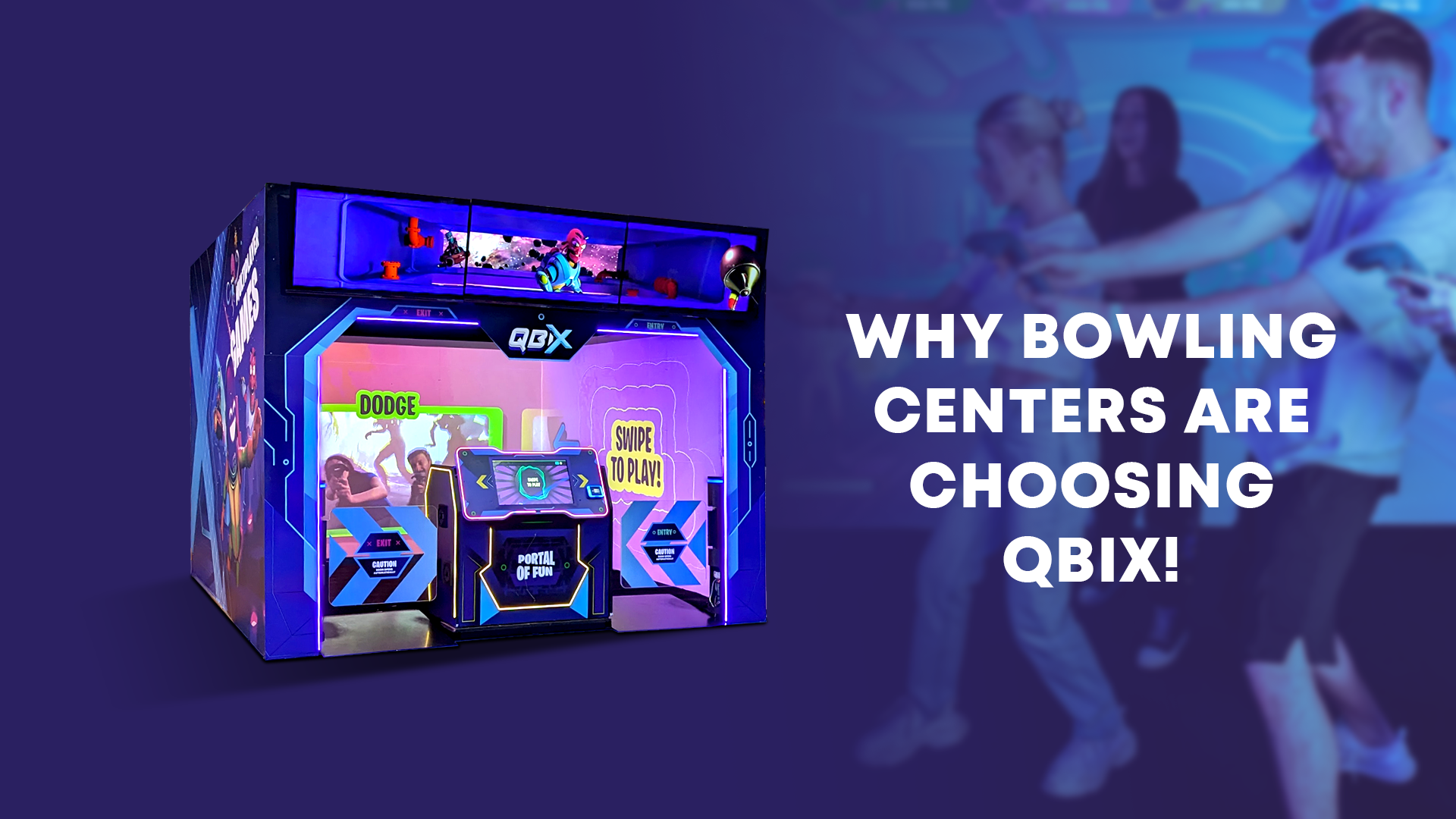
QBIX is a 13 x 13 ft immersive gaming room built specifically around the group play principle. With up to 6 players at once, all inside the room together.
It is one of the clearest examples in the market of the Experience Economy applied at the attraction level, where the product is designed not around the individual player but around the shared moment the group walks away with.
That dimension is physical and shared.
The 10-year-old feels it, mom feels it, the teenager who thought they had seen everything feels it. And because they all feel it at the same time, they react together, talk about it together, and immediately want to go again.
Keith Ferraro at The Fun Spot in Queensbury, New York, had been running a VR arena before installing QBIX. He watched what happens when novelty fades without a shared group play layer underneath it.
“People saw VR and said, ‘I’ve done that already.’ I needed something that felt new, something they hadn’t experienced before, and they simply can’t do at home.”
Keith Ferraro, Owner, The Fun Spot
He bundled QBIX into day passes and invited families, teenagers, and adults inside, without changing his floor layout or adding headcount. Guests walk up, swipe at the kiosk, and they are in: the session runs itself.
At AR’s Entertainment Hub, operating three Texas locations on an all-access pass model, the site manager in San Antonio described QBIX as filling the need for “a group activity that’s something just out of the normal, but still really interactive. Families, friends, anybody from any age.”
Related: How AR’s Entertainment Hub Added QBIX Play to Their All-Access Pass: And What Happened Next
The Experience Economy has been making this argument since 1998. What has changed in 2025 and 2026 is that guests are now experienced enough to feel the difference between an attraction designed for the individual and one designed for the group they came with, and they are making decisions accordingly.
The question is not whether group experiences outperform solo attractions. The data has already answered that.

Request a Quote for QBIX!
If you want to see what it looks like for your venue: pricing & how it fits your mode, we're happy to put together a quote!


Subscribe to us